Quality in construction directly influences the safety, durability and performance of any structure. Understanding Quality Control & Quality Assurance in Construction is essential for civil engineers, site supervisors, contractors and project managers who must ensure that every material, every procedure and every execution step meets required standards. This guide explains the QC/QA system, material testing methods, site inspection process, checklists, documentation requirements and Indian Standards relevant to construction quality.
1. What Is Quality in Construction?
Quality in construction refers to the degree to which a completed structure meets the specified requirements of design, materials, workmanship and performance. A construction project is considered high quality when every component—foundation, concrete, reinforcement, masonry, finishes and services—conforms to approved drawings, IS codes, contractual specifications and industry best practices. Quality also includes the structural integrity, durability, safety, serviceability and long-term performance of the building under expected loads and environmental conditions. Achieving quality requires proper planning, skilled execution, accurate testing, continuous inspection and strict adherence to established procedures throughout the project lifecycle.
Quality in a construction project means:
- The structure meets design specifications
- All work follows IS codes and standard practices
- Materials comply with strength requirements
- Workmanship is uniform, safe and durable
- The finished project performs as intended
Below are generic images representing quality inspection, testing and construction verification:



2. Difference Between Quality Assurance (QA) and Quality Control (QC)
| Aspect | Quality Assurance (QA) | Quality Control (QC) |
|---|---|---|
| Focus | System, process, standards | Actual materials & workmanship |
| Objective | Prevent defects | Detect defects |
| Responsibility | Management, planners | Site engineers, supervisors |
| Timing | Before and during project | During and after execution |
| Examples | SOPs, checklists, training | Cube tests, slump tests, inspections |
Civil engineers must understand that QA prevents problems, while QC detects and corrects them.
3. Importance of QA/QC in Construction
- Ensures structural safety
- Reduces failures, cracks, leakage, shrinkage
- Decreases rework and overall project cost
- Ensures compliance with drawings and contracts
- Ensures public safety and reliability
- Builds contractor reputation and credibility
4. QA/QC Flow in a Construction Project
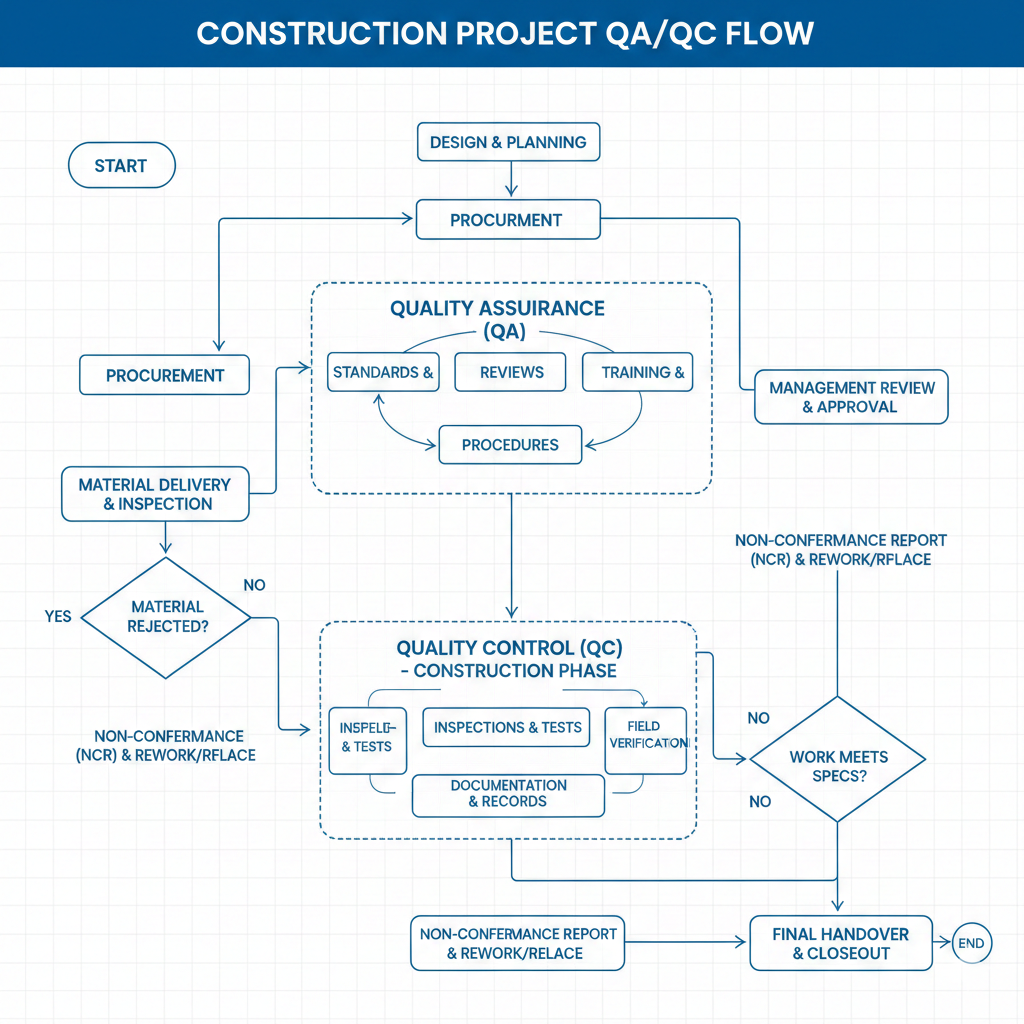
A typical QA/QC workflow includes:
- Review of drawings & specifications
- Preparation of QA plan
- Material inspection & testing
- Method statements & work procedures
- Site supervision & execution control
- Sampling and testing
- Non-conformance reporting (NCR)
- Documentation and approvals
5. Material Quality Control in Construction
Materials used on-site must meet engineering standards. Material testing is the backbone of QC.
5.1 Cement Testing
Cement testing in construction ensures that the material used in concrete and mortar meets the required strength, durability and consistency standards. Before approving any batch, civil engineers verify key properties such as fineness, standard consistency, initial and final setting time, soundness and compressive strength. These tests help determine the water requirement, workability, rate of hydration and long-term performance of cement in structural elements. Proper cement testing prevents issues like low strength, cracks, excessive shrinkage and delayed setting, ensuring that the concrete produced on site performs safely and reliably throughout the structure’s lifespan.
| Test | Purpose |
|---|---|
| Fineness | Determines particle size |
| Consistency | Water requirement |
| Initial & final setting time | Workability duration |
| Compressive strength | Structural strength |
5.2 Concrete Testing
Concrete testing in construction ensures that the material delivered, mixed and placed on site meets the required strength, workability and durability criteria specified in the design. Tests such as slump testing assess workability and consistency before placement, while cube compressive strength tests verify whether the concrete achieves its characteristic strength at 7, 14 and 28 days. Additional checks like air content, temperature, water–cement ratio control, and sampling frequency specified in IS 516 and IS 1199 help maintain uniform quality across batches. Proper concrete testing prevents structural defects, reduces long-term maintenance issues and ensures compliance with engineering standards, making it an essential part of any QA/QC process on site.
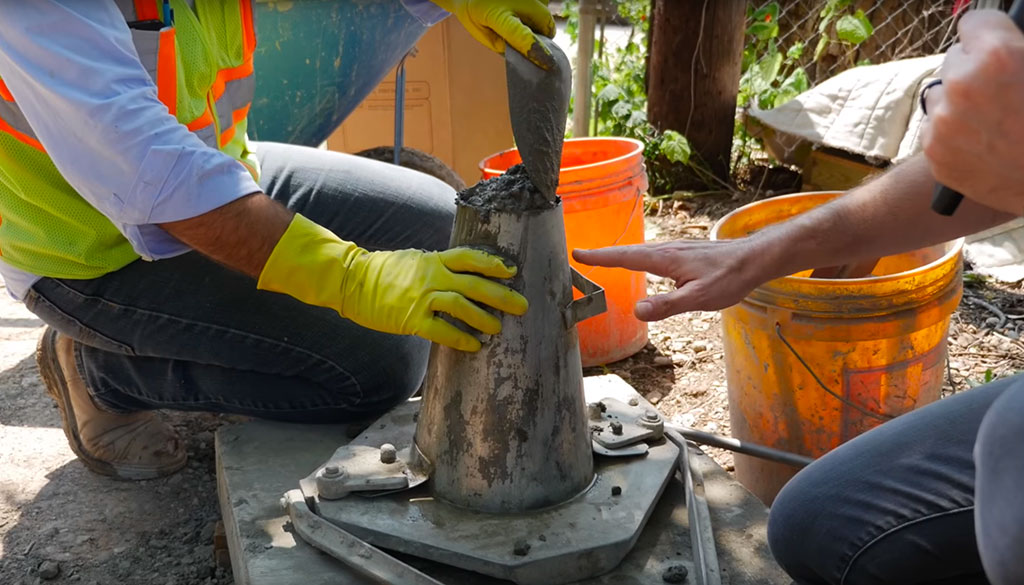
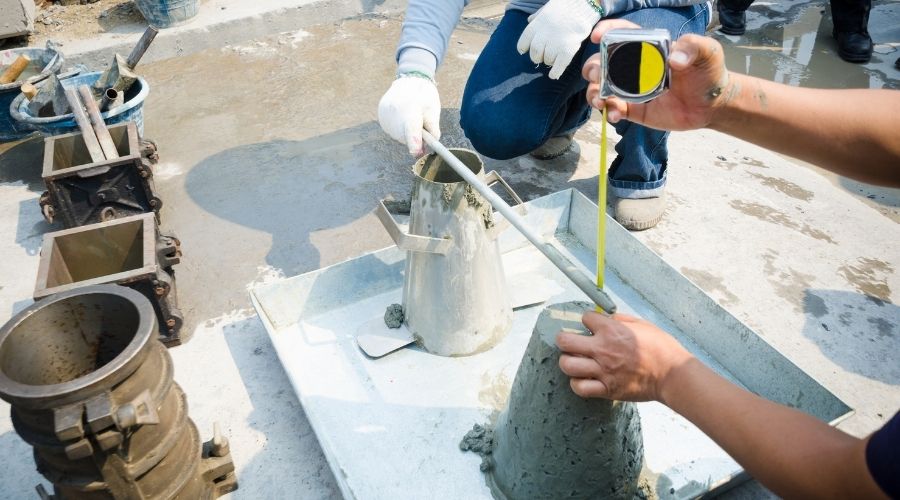
Tests include:
- Slump test
- Cube compressive strength test
- Air content test
- Mix proportion verification
- Workability measurement
5.3 Steel Testing
Steel testing in construction ensures that reinforcement bars used in RCC structures meet the required strength, ductility and chemical composition standards specified in IS 1786. The two most important tests are the tensile test, which determines yield strength, ultimate strength and elongation, and the bend and rebend tests, which confirm the ductility and ability of steel to withstand deformation without cracking. Additional checks such as weight per meter verification, chemical analysis for carbon, sulfur and phosphorus content, and visual inspection for rust, lamination or surface defects help ensure consistency and safety. Proper steel testing prevents structural failures, controls quality at the source and ensures that reinforcement performs reliably under load and environmental conditions throughout the life of the structure.
| Test | Purpose |
|---|---|
| Tensile strength | Load-carrying capacity |
| Bend test | Ductility |
| Chemical composition | Quality of alloy |
5.4 Aggregate Testing
Aggregate testing in construction ensures that coarse and fine aggregates used in concrete and road works meet required strength, durability and performance standards. Key tests include sieve analysis for grading, specific gravity and water absorption for density and porosity, crushing value and impact value for mechanical strength, and flakiness–elongation index for shape quality. These tests help confirm that aggregates will produce strong, workable and durable concrete capable of withstanding load, abrasion and long-term weathering.
- Sieve analysis
- Specific gravity
- Water absorption
- Crushing value
- Impact value
6. Workmanship Quality Control
Workmanship QC verifies that construction tasks are executed to specification, with correct alignment, compaction, reinforcement placement and curing, ensuring durability and minimizing defects.
QC checks include:
- Correct reinforcement placement
- Bar bending as per BBS
- Proper compaction of concrete
- Adequate curing
- Proper shuttering alignment
- Clean surface preparation
- Tolerance checks using levels and plumb lines
Workmanship failures lead to cracks, deflection, water seepage and structural weakness.
7. QA/QC Checklist for Major Construction Works
7.1 Earthwork & Excavation
- Check soil classification
- Confirm excavation depth
- Ensure side slope stability
- Dewatering (if necessary)
7.2 Foundation
- Reinforcement checks
- Shuttering accuracy
- Concrete quality
- Curing method
7.3 Masonry
- Brick quality
- Mortar mix proportion
- Joint thickness
- Plumb and alignment
7.4 RCC Works
- Bar spacing
- Cover blocks
- Shuttering stability
- Slump and cube tests
7.5 Finishing Works
- Plaster thickness
- Tile leveling
- Paint finish uniformity
8. Site Inspection Process
Step 1 — Pre-Inspection
Review drawings, specifications and method statements.
Step 2 — During Execution
Continuous supervision, testing and measurements.
Step 3 — Post-Inspection
Verification with measuring tools, testing reports and tolerance checks.
Step 4 — Documentation
Inspection reports, NCR reports, corrective action logs.
9. Non-Conformance Report (NCR)
NCR is raised when:
- Material fails testing
- Work does not match drawings
- Defects appear after casting
- Safety or workmanship issues exist
An NCR includes:
- Description of non-conformance
- Root cause
- Corrective action
- Preventive action
- Verification record
10. Documentation in QA/QC
Documentation proves that the work satisfies quality requirements.
Essential QA/QC documents:
- Inspection Test Plan (ITP)
- Checklists
- Concrete pour cards
- Material test reports (MTR)
- Calibration certificates
- Site inspection reports
- NCR logs
- Daily progress reports
11. IS Codes for Construction Quality
Civil engineers frequently use these codes:
- IS 456 – Code for RCC
- IS 383 – Aggregates for concrete
- IS 10262 – Concrete mix design
- IS 516 – Concrete strength tests
- IS 1786 – Steel reinforcement
- IS 2502 – BBS preparation
- IS 9103 – Admixtures
- IS 3025 – Water quality for construction
Following codes ensures uniformity and safety.
12. Modern QA/QC Tools in Construction
Digital QC tools include:
- Construction management software
- Mobile QA/QC apps
- Digital forms for inspections
- Drone inspections
- Laser scanning for accuracy
- BIM-based quality workflows
13. Common Causes of Poor Quality
- Lack of supervision
- Unskilled labour
- Wrong material mix
- Poor curing
- Improper shuttering
- Non-compliance with codes
- Rushed schedule
Civil engineers must identify and eliminate these risks early.
14. Quality Assurance Plan (QAP)
A QAP includes:
- Project scope
- Applicable codes
- Material testing frequency
- Work procedures
- Inspection plan
- Acceptance criteria
- Documentation format
A well-written QAP prevents quality failures and disputes.
15. Benefits of Implementing Strong QA/QC
- Higher structural durability
- Fewer repairs and rework
- Compliance with legal standards
- Better client satisfaction
- Reduced long-term maintenance costs
- Improved project reputation
Conclusion
Quality assurance and quality control are essential pillars of successful construction management. When executed properly, QA/QC ensures that materials, workmanship and processes meet engineering standards, resulting in safe, durable and high-performance structures. Civil engineers must follow codes, maintain documentation, conduct tests and monitor execution at every stage to achieve consistent quality. A strong QA/QC culture leads to long-term project reliability and professional excellence.
Recommended Resources
Bureau of Indian Standards
https://bis.gov.in
NPTEL – Construction Quality Management
https://nptel.ac.in
OSHA Construction Safety & Quality
https://www.osha.gov
American Concrete Institute (ACI) Resources
https://www.concrete.org